Any odd USB keyboard will of course work with a Mac (with Mac OS X allowing you to swap the modifier keys as you see fit), but if you’re after a mechanical keyboard that also has the Mac-specific symbols printed on its keycaps, then your options are more limited:
- There’s the Das Keyboard, which has an odd-dual USB pass-through arrangement as well as a glossy black plastic finish, which attracts fingerprints rather nicely.
- Another option is the Tactile Pro, whose look and design I just don’t get on with at all.
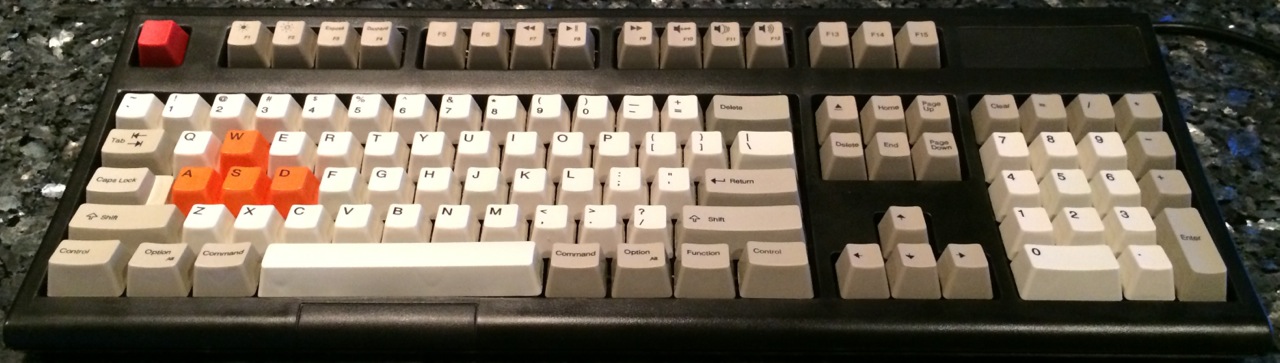
- If you want to go for a keyboard with Buckling Spring switches instead of the usual assortment of Cherry MXs, the only option is the Unicomp Spacesaver M.
- A rather custom option is provided by the WASD Keyboards: They build you a keyboard with laser etched or engraved custom keycaps from your design (and they have a pre-made Mac layout).
I have a few more thoughts to offer on both the Spacesaver M as well as WASD V2 keyboards, as I bought one of each. Note: Noise is no consideration as these are my “home” keyboards.
Unicomp Spacesaver M
The keyboard feels heavy and very solid, although the finish of the plastic is not of very high quality. The seams are uneven and if you put pressure on the case, you can hear the plastic creaking. The design of the Mac-specific keycaps is rather slap-dash and not done with much care (no symbols for ⌘ or ⌥, odd alignment of symbols and text on the function keys). The ugly Unicomp logo fits right in (but you can order a cheap Black No LED Overlay from them — just lift and detach the existing one with a sharp thin blade and put the neutral one in its place).
All that being said, I do actually like the look of the black case with the dark grey modifier keys with the lighter keys.
The switches themselves are really nice and I enjoy typing on them. They keys are comparatively high and have a good amount of stroke depth.
The key-mapping enables the Mac-specific shortcuts (Expose, Volume, Media Keys) on the F-keys by default, and you have to hold the Function (fn) key to get to the normal F-keys. You can lock (and unlock) the fn-key state by pressing Left-Shift + fn if you prefer to mainly use the F-keys directly (but you need to remember to redo this after every sleep / wake cycle).
The USB-interface takes a fair amount of time to wake up from a sleep-state (even longer if you used the keyboard itself to wake the computer), so you’ll usually to wait 3-4 seconds without key presses for the keyboard to re-initialise itself.
After a few weeks, my Spacesaver M developed problems with certain keys not registering (usually after Sleep), but replugging the keyboard seemed to fix it. After a while a (different) set of keys stopped responding altogether, and no amount of rebooting, replugging or shaking would fix it. After contacting Unicomp, they thankfully offered to ship me a replacement keyboard (even though their warranty statement specifically excludes warranty for internationally shipped products: Thanks, Jeanne!). The replacement worked fine for a while, but then developed very similar problems with a subset of keys no longer registering at the host.
Last weekend I finally found the time (and the needed 5.5mm nut) to open one of those keyboards up, and it turns out that the internal plastic ribbon cable, onto which the keyboard controller board (which is labelled Ruffian_V4_2) is directly screwed on top of, is not making full contact. The holes in the plastic have been partly ripped out and the alignment between the contacts on the backside of the controller board and cabling plastic sheet was misaligned. After a few attempts at reseating and realigning the controller board and the plastic sheet (and not screwing the board back in place too tightly because that prevented contact again) I seem to have repaired keyboards. I don’t know whether the connection between the plastic sheet and controller is that failure-prone, or whether international transport played a role, but my two keyboards (original + replacement) failed with exactly the same symptoms (and similar internal damage to the ribbon cable’s screw holes from the affixing of the controller board).
WASD V2 87-Key Custom Keyboard
After the Spacesaver M repeatedly failed (and before I figured out that I was able to repair them), I was looking for alternatives, and via Jeff Atwood’s CODE keyboard found out about WASD Keyboards. The CODE keyboard itself was of no particular interest to me, as it has Windows-keycaps as well as a backlight. It did have a configurable key-mapping, though (via DIP-switches).
Nonetheless, a closer look revealed that WASD will make a keyboard with anything you want printed on it (by giving them an Adobe Illustrator or PDF file from a defined template), and that their “normal” (non-CODE) keyboards have the same configurable keyboard controller. I had no interest in making my own custom layout, but they provide a very decent pre-made Mac-layout.
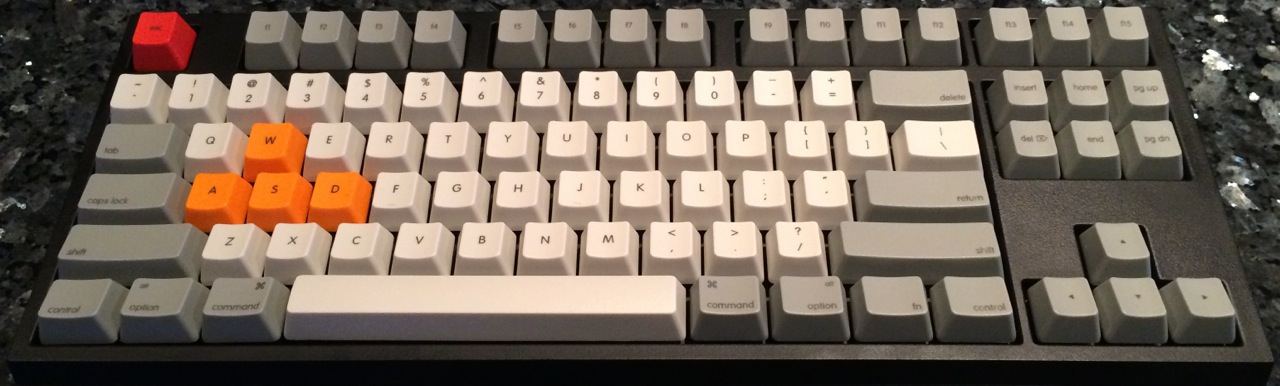
After some back and forth between the normal (102 keys) or tenkeyless (87 keys) version (which unfortunately are the same price — I’d have thought buying less plastic, switches and keys would’ve resulted in some savings…) and then a short interlude in the customs office, I obtained my custom keyboard with Cherry MX Blues:
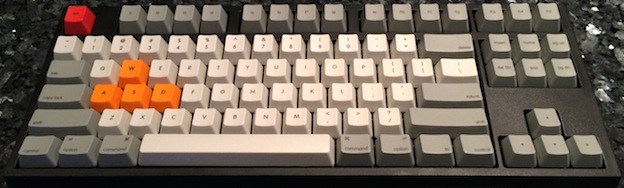
The design is very understated, with sharp edges and very little flourish or extraneous plastic. The case and finish is of a very high quality and I was positively surprised with the quality of the lettering; it does not look custom or one-off at all. After configuring the DIP switches (1 and 6 to ON for enabling the Mac-layout and the fn-key), it behaves like a proper Mac keyboard. In contrast to the Spacesaver M, the Function-keys only map to the function keys (and not any Mac specific functions) which I actually prefer. fn + insert / home / delete / end keys control media playback and fn + f13 acts as ⏏. Also nice is that the controller initialises very quickly after a USB-wake event.
The feel of the key-switches is nice (although the odd key initially seemed a bit reluctant to return back to its resting state after releasing it) but not quite as satisfying the Spacesaver M. It’s taken a bit more effort to get used to a keyboard without a number block than I would’ve though, even though I work at a laptop all day at work. This is mainly because the subtle cue from my right pinky of the right side of the keyboard ending used to indicate the start of the number block, not the navigation keys.
In closing
Now that both keyboards are in a working state (as I’d ordered the WASD as a replacement after the replacement Spacesaver broke down and before I’d managed to repair them), I’m typing this on the WASD keyboard. I do actually prefer the feel of the buckling springs to the Cherry switches, but overall the WASD feels like it has much more care put into it, with a better finish and USB controller. That said, it is also a fair bit more expensive. Both are enjoyable keyboards, but you should not order a Spacesaver M expecting a high quality plastic case and finish — you can expect high quality switches, though.